
Languages of Zambia: Interactive (EN)
[siteorigin_widget class=”WP_Widget_Custom_HTML”][/siteorigin_widget]
Resource 3 – external link

How to consider language when researching sexual exploitation, abuse, and sexual harassment (SEAH)
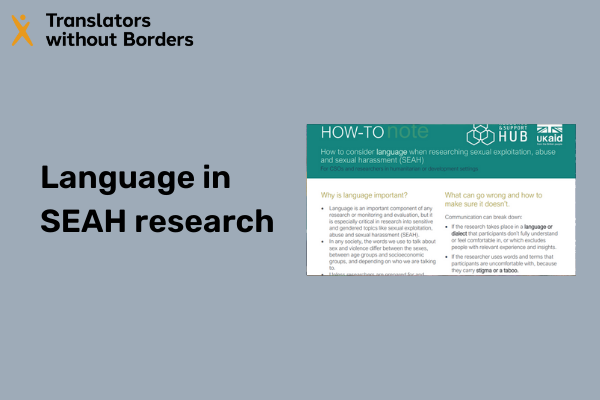
This how-to note details why language is important in researching Sexual Exploitation, Abuse and Sexual Harassment (SEAH), what can go wrong and how to mitigate the risks and how to ensure we use the right language when talking about SEAH and safeguarding in research. Download the document in: Amharic, Arabic, English, French, Hausa, Swahili and […]
Language data for Peru
The 2007 Census of Peru records just four major languages, although over 72 Indigenous languages and dialects are spoken in the country. Around 84% of Peruvians speak Spanish, the official national language. Even so, over 26% of the population speaks a first language other than Spanish. Quechua is the second most commonly spoken language (13%), […]
Languages other than Spanish in Peru Map: Static (EN)
Static map highlighting the places where languages other than Spanish are used the most in Peru. Data is from the 2007 census.
Languages of Peru: Interactive (EN)
[siteorigin_widget class=”WP_Widget_Custom_HTML”][/siteorigin_widget]
Afghanistan Community Radios language map: static (EN)
Static map showing the primary language used for broacasting by local community radios. Data is from a 2021 survey. Click here to download.
Afghanistan Community Radios reach by language: static map (EN)
Static map showing the reach for each language used for broacasting by local community radios. Data is from a 2021 survey. Click here to download.
Language Questions in Humanitarian Data Collection
LANGUAGE QUESTIONS IN HUMANITARIAN DATA COLLECTION Language-related questions for new and ongoing surveys If aid organizations are to communicate effectively with the people they aim to help, in the languages they are most comfortable with, they need to know what those languages are. Existing language data is often outdated and does not necessarily reflect large-scale […]
Language Data Initiative
LANGUAGE DATA INITIATIVE TWB’s Language Data Initiative is putting language on the map in the humanitarian and development sector. There is little information available on the languages crisis-affected people speak and understand. Humanitarians often develop communication strategies without reliable data on literacy, languages spoken, or preferred means of communication. The result too often is that […]