
The human-centered design process (HCD)

HCD is a set of participatory principles that find solutions to problems through learning, improving and adapting in a highly participatory process that involves the intended users. In a constantly evolving environment.
This process can help teams maintain a focus on inclusive solutions that are continuously informed by new opportunities and challenges. While this toolkit is not a comprehensive “how-to” manual on HCD, it connects core HCD principles with real-life humanitarian constraints.
Phases of human-centered design with crisis-affected people
Click on each phase
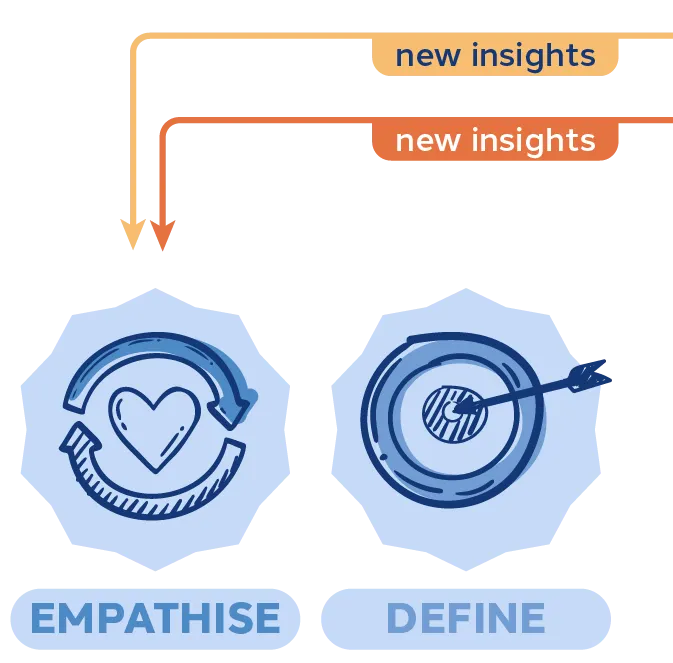
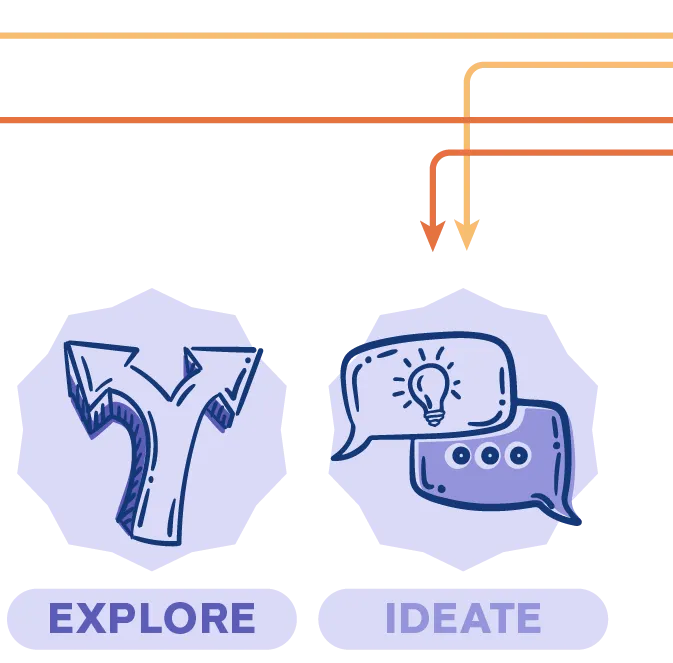
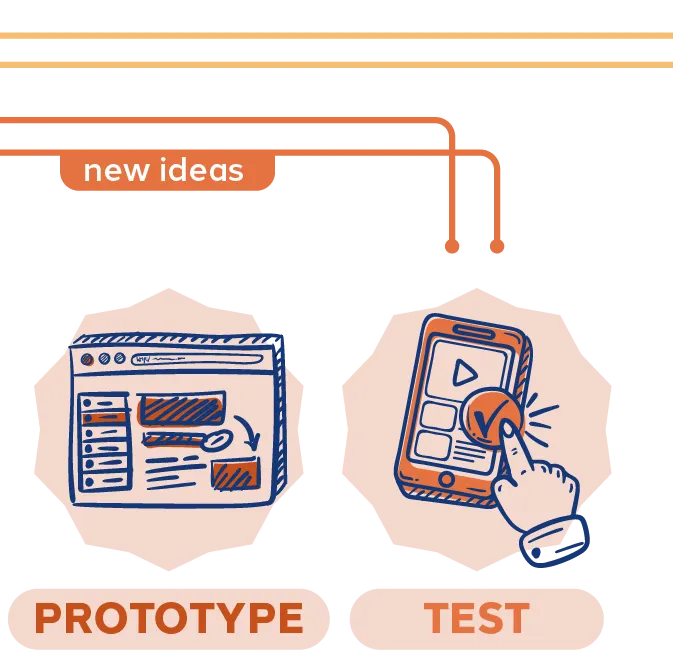
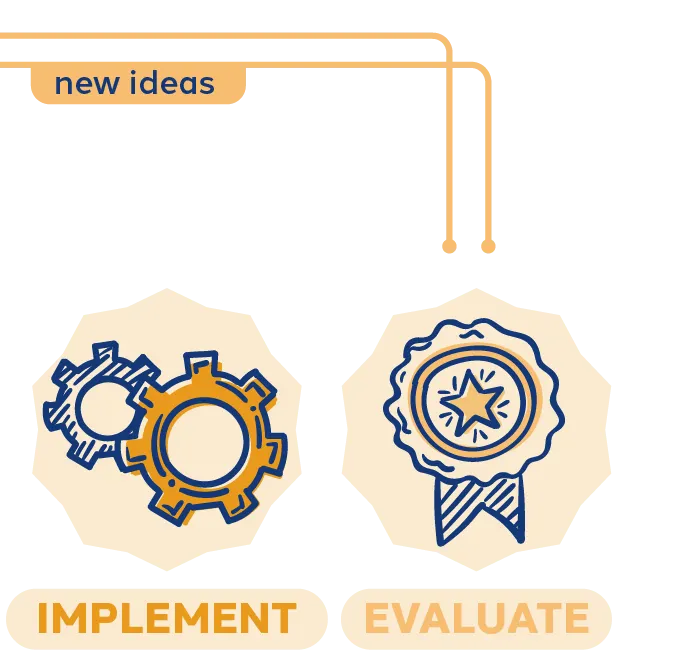
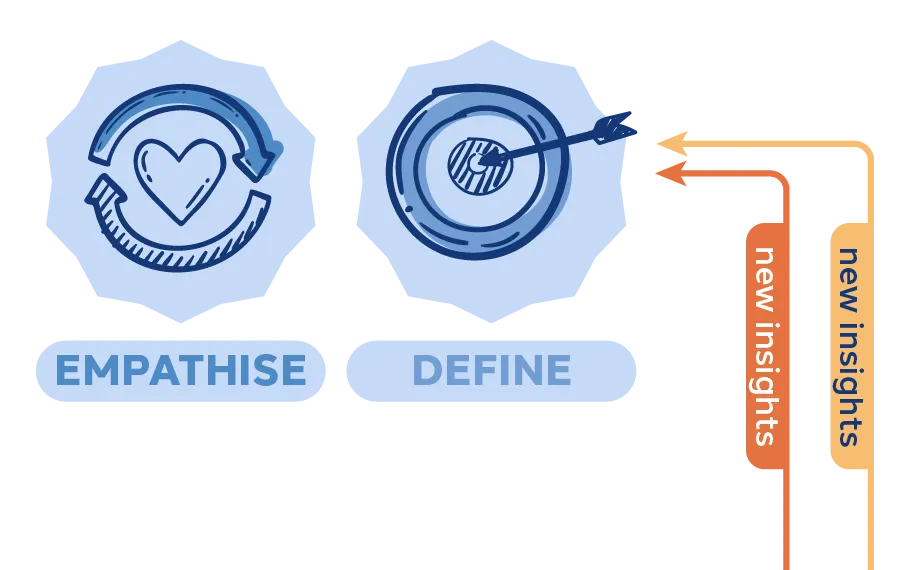
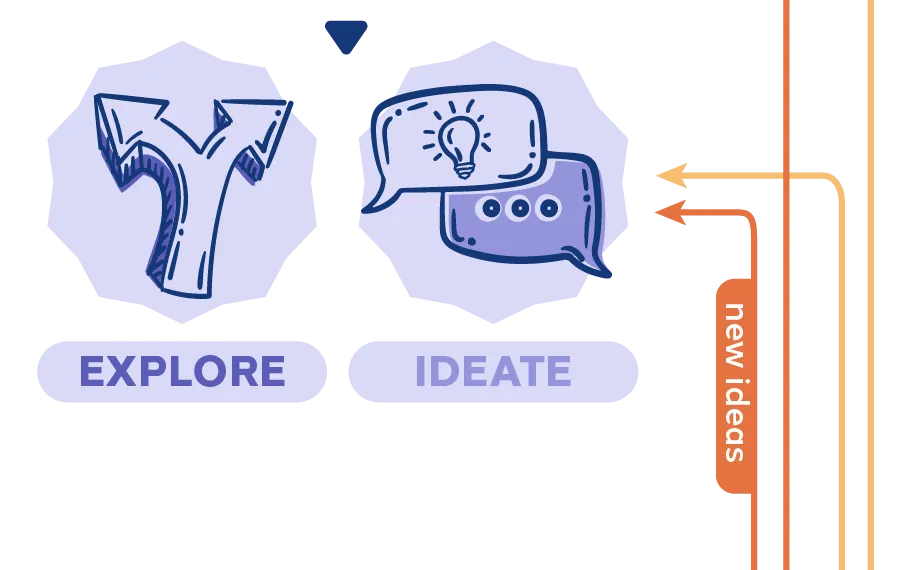
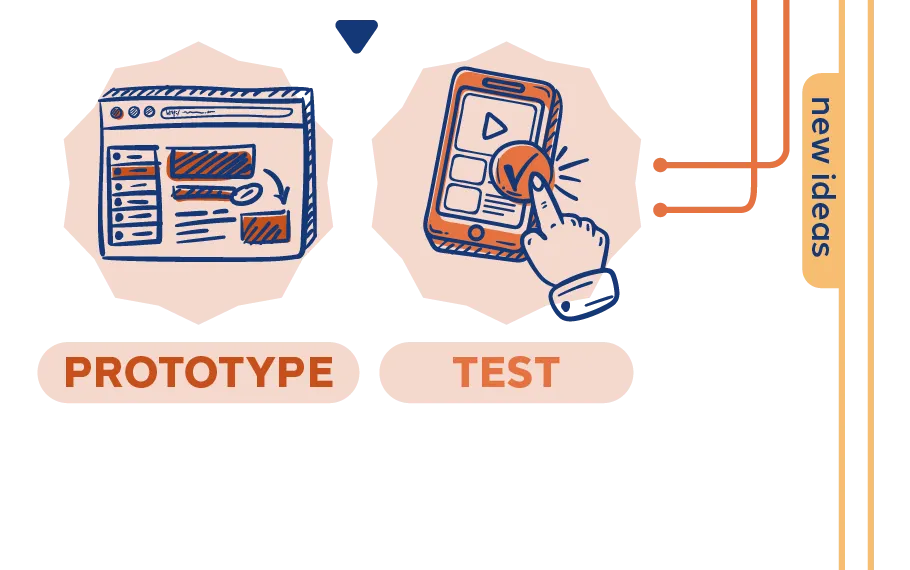
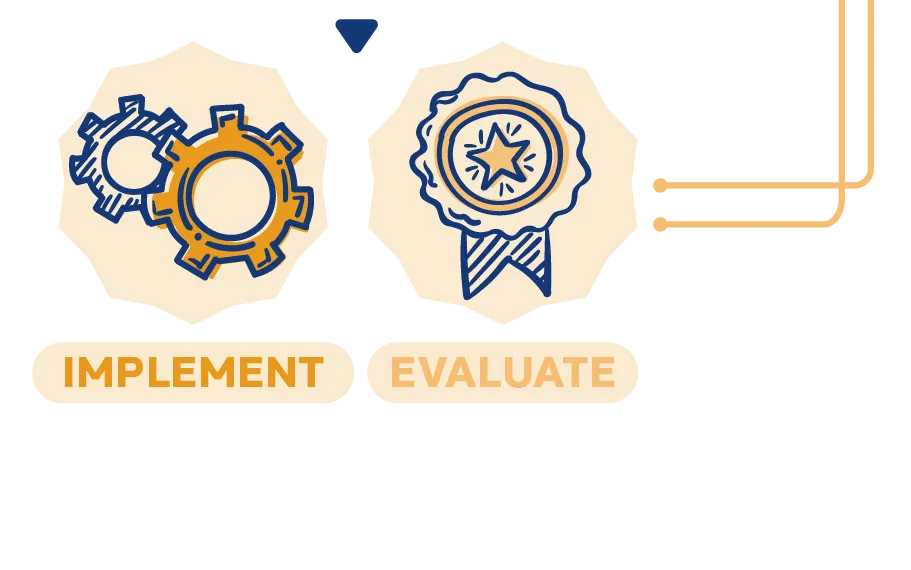
The process follows an iterative cycle of learning, improving, adapting, and launching new features to drive adoption and engagement.
Click on each phase, you will find:
- The general objective of the phase
- Activities to execute the phase
- Considerations
- A downloadable tool to help you in the process
The process follows an iterative cycle of learning, improving, adapting, and launching new features to drive adoption and engagement.

EMPATHISE

DEFINE
Empathise and define
Keep an open mind: digital technology might not always be the best or only solution. In this phase, focus on understanding people’s problems, goals and aspirations. Look for constraints and opportunities rather than settling on a solution independently of the collaborative process
Objective
Build a foundational understanding of people’s actual needs, challenges, and capabilities.
Activities

User research
Conduct focus group discussions, key informant interviews, co-creation sessions and observational research (where feasible).

Needs assessment
Determine whether existing assessments capture relevant technology-related information (access to devices, digital skills and confidence, connectivity). If not, gather additional data where possible.

Stakeholder analysis
Identify formal and informal leaders, existing community structures such as disability, women’s and protection committees, influencers, and gatekeepers.

Information needs
Ask people during community consultations what information they need on the options and associated risks. Clarify why the consultation is happening, how findings will be used, and when participants will receive updates.
Emergency considerations for the empathise and define phase
- What challenges do people face in accessing services they are eligible to receive?
- Which specific sections of the population are excluded or underserved
- Consider young people, women and girls, older adults, people with disabilities, minorities, and other marginalised groups.
- Which languages do people speak, read, and prefer for communication with aid providers?
- Do preferences differ between speaking, reading, and writing?
- What challenges do humanitarians face in providing services and reaching the people they aim to serve?
- What access to digital technology do people have?
- Devices
- Internet
- Electricity
- Money to pay for devices or data
- What applications are people already using?
- What digital tools do people use to communicate with aid providers?
- What digital tools, communication channels, or information sources do people avoid using, and why?
- Do people know how to check whether information they find online is accurate?
- Does the humanitarian response have a process for monitoring and responding to rumours or misinformation?
- How do people feel about using digital technology?
- What do they dislike about the tools they currently use
- What is the level of trust or scepticism towards digital technology, and why?
- What value would digital technology bring compared to non-digital interventions?
- If humanitarian staff are direct or indirect users, what are their challenges, preferences, and current technology use?

EXPLORE

IDEATE
Explore and ideate
Start thinking about solutions to the problems identified. Allow a creative process at first to support innovative thinking.
Objective
Translate research findings into actionable problem statements and potential solutions.
Activities

Define the problem
Clearly articulate what problem the digital solution aims to address, who faces it, and why digital technology might help.

Ideation sessions
Brainstorm as many ideas as possible with tools like user personas and journey mapping, then agree on a few relevant and feasible solutions to develop further.

Risk assessment
Consider aspects such as: data privacy, security, feasibility, and potential harm.

Participation strategy
Discuss with people how they want to be involved in subsequent phases – testing, feedback loops, monitoring, communication, etc.
Capacity building or sensitisation sessions might be needed at this stage to ensure communities understand the possibilities and risks of digital solutions.
Emergency considerations for the explore and ideate phase
- Invite diverse groups of people to ideation sessions and ensure they feel safe and comfortable to participate.
- Consider whether separate sessions are needed for women and for men to encourage trust and more candid sharing of insights.
- Make sure the venue is private, so that participants cannot be observed or overheard by others.
- Separate sessions may also be advisable for people who are more comfortable with digital technology and those who feel less confident.
- Don’t exclude project staff, who will probably be the first point of contact for people regarding questions and concerns about the digital solution.
- Evaluate the participatory process as it was initially designed. It may need adapting now you have more information and a better understanding of the challenges that crisis-affected people face.
- What data protection policies are applicable and required in this location?
- Identify what will be required and the implications for the digital solution.
- What is the best strategy for encouraging adoption?
- Who are the influencers, the formal and informal leaders, that need to be involved in this process?
- Explore options for uptake and relevance, for example through linking to existing platforms.
- Explore options for inclusion and accessibility, for example voice-based technology to include women and other marginalised groups. This implies going beyond the influencers and talking to representatives of different groups.
PROTOTYPE

TEST
Prototype and test
Prototyping is about learning, not just building. Expect multiple iterations.
This is an opportunity to discover challenges and opportunities that were not explicitly articulated in the earlier stages of data collection. When individuals and groups are presented with something tangible, their feedback will also be more actionable.
Objective
Develop early versions of the solution (prototypes) and gather feedback from users. A prototype can range from a simple mockup to interactive screens to more functional implementation simulating a system. Identifying improvements and necessary design adaptation early before a full product or service is implemented allows substantial savings on both budget and time.
Activities

Scope the product or service
With community input, define which features are essential to improve assistance and services and which are desirable.

iterative prototyping
Start small, with mock-ups or simplified prototypes that can be tested quickly.

User testing
Share prototypes to gather input on usability, language, content, and overall experience.

Integrate feedback
Refine designs based on the test results. This might include reworking user interfaces, adjusting language, or adding or removing features.

Ethical considerations
Ensure transparency about data use and build consent processes into the prototyping.
Emergency considerations for the prototype and test phase
- Is the aim to provide one digital solution for all groups or different channels of communication using non-, low- and high-tech solutions so that everyone is included
- Prototyping is an opportunity to explore different ideas and present them to the target audiences to evaluate.
- This is the stage where assumptions can be made and tested for accuracy.
- Can inclusion be built in phases, first onboarding people with lower barriers to access while making preparation for others?
- Can community members with more experience of digital technology act as trusted community champions to help reach more individuals
- Consider providing compensation for user testing participants.
- Make sure community testers get what they need to participate fully and confidently, including:
- A safe space during testing activities to to freely express their opinions, thoughts, ideas and concerns while interacting with the tool
- Assurance that this is not a test of their ability to use the tool, but that the aim is to validate its usefulness and relevance to the community
- Clear and simple instructions on the exercise in their own language, verbally if needed
- Assurance that their feedback will not in any way affect their right to receive aid
- Engagement on their terms, whether that relates to the time of the day, location or frequency of their input
- Information on the next steps once all feedback is collected, ideally with updates on which changes are made, which are not and why

IMPLEMENT

EVALUATE
Implement and evaluate
Launching the tool in communities is a milestone that requires close monitoring and continuous evaluation, including from users’ perspectives.
Objective
Launch the digital solution, monitor its performance in real-world conditions, collect feedback and improve.
Activities

Rollout and communication
Inform and train relevant groups, humanitarian staff, and local partners.

Monitoring and feedback loops
Track user adoption, issues, and overall satisfaction. Share progress with the community to build trust and transparency.

Adaptation
Because humanitarian contexts change rapidly, continuously evaluate whether the tool remains relevant and addresses evolving needs.

Sustainability and handover
Work towards transferring ownership to local stakeholders. Identify champions (community members, local organisations, etc.) to maintain momentum.
Emergency considerations for the Implement and evaluate phase
- Provide clear, informative and validated user guidance, in the right language and format (plain language, in the languages and formats to be accessible to all).
- Identify community champions or “super users” who can support others, relay important insights, and gather feedback.
- Establish automated feedback loops and ongoing check-ins.
- Inform the community on evaluation activities and what action is taken in response.
- Define indicators and build dashboards that allow people to monitor engagement; tailor the metrics to what is interesting for users, the wider community, and external stakeholders.
- Find channels to keep people regularly informed about learning and next steps.
- Start planning a transfer of ownership to local stakeholders.
- Offer capacity building if necessary.
- Establish maintenance and support processes.
- Design promotional material and a dissemination plan in participation with community members – how to communicate, and when?
Ensuring participation in an emergency
The time pressures of humanitarian action create particular challenges for how this process is implemented, and call for flexibility.
The first phase – understanding and empathising with the people facing a problem – may require extensive planning, especially when uncertainties are high. But that time frame can be shorter when reliable data exists on factors like connectivity, communication channels, literacy, and the languages people speak and read. In such cases, rapidly testing assumptions with user can be more efficient than conducting additional research.
What level of participation is possible and appropriate depends on the nature and phase of the emergency. In protracted crises or recovery phases, there is generally more time and opportunity to engage affected people in collaboration, co-creation, and full empowerment. In a rapid-onset emergency like an earthquake or fast-escalating conflict, immediate life-saving action takes priority, and participation may initially be limited to providing information.
However, even in rapid-onset emergencies humanitarians should aim to integrate community participation as early as possible and transition to higher levels of participation as the situation stabilizes. The approach must remain flexible and context-sensitive, balancing urgent activities like search-and-rescue operations after a disaster with the long-term goal of community leadership and decision-making.

IDEO.ORG is a pioneering organization in human-centered design that offers toolkits and online courses
Here I Am: A design studio focused on digital technology and design for and with vulnerable communities, especially women and girls. Relevant resources include:
Data Science Nigeria has developed AI in Hausa and Yoruba showcasing local languages and inclusive capacity-building efforts.
ICTWorks
Nesta: The United Kingdom’s innovation agency for social good has developed a Playbook on collective intelligence design. Learn more about how data-driven innovation can be designed collectively.
RAND Europe: A not-for-profit research organisation providing recommendations for humanitarian practitioners and organisations for developing and implementing emerging technology.
ALNAP: The global network for advancing humanitarian learning has published research on
DevEx: A short but useful article on
Who to involve