
Who to involve
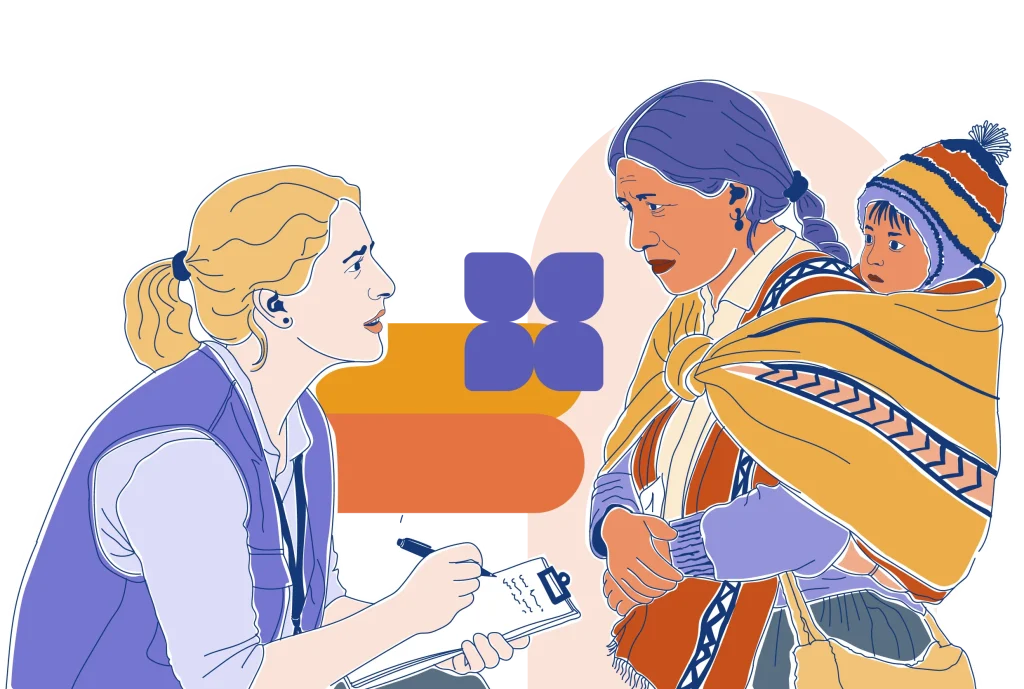

Participatory approaches to humanitarian technology
People affected by crises should not be passive recipients; they must have a voice and agency throughout the design, implementation and evaluation of digital solutions.
Substantive participation by people impacted by crises is increasingly seen as vital for informed humanitarian service design and delivery. Yet community involvement is still seen as a one-way information-sharing process. Even if it is more than that, the process is often consultative rather than transformative and gives people little influence and in-person presence when decisions are made. With digital tools now playing a larger role in humanitarian action, a participatory and bottom-up methodology is more essential than ever.
Informing
Description
Providing information to people.
Useful when: progress, changes, or results are shared.
Decision-making power
They don’t make decisions, but they understand what is being done and why.
Consultation
Description
Gathering feedback to inform decision-making.
Risk: extractive participation if there is no feedback.
Decision-making power
External decision-makers hold final authority
Collaboration
Description
Actively engaging people in implementation.
Assistance in: Strategic in the phases of human-centered design
Decision-making power
External organisations still control decision-making
Co-creation
Description
People actively participate in defining problems and solutions.
This is the core level of human-centered design.
Decision-making power
Equal decision-making power between people and organisations
Empowerment
Description
People affected by a crisis lead and manage the intervention
Ideal for: technologies with long-term impact or high risk.
Decision-making power
Decision-making power requires clear agreements, trust, and sustainability. Full control by affected people

Who to involve
Conduct a stakeholder analysis. For maximum inclusiveness and accountability to affected people, look beyond the “usual” entities and individuals in a community and strive to include women, people with disabilities, adolescents, and others whose voices are less often heard.
Stakeholders informing the design and main participants in the process
Crisis-affected people
Crisis-affected people are individuals and groups directly impacted by humanitarian crises and the primary users of digital technologies developed in these contexts. They bring lived experience, contextual knowledge, and an understanding of daily realities that cannot be replicated by external actors. This group is not homogeneous and includes people of different ages, genders, occupations, abilities, and living conditions across rural and urban settings.
They may already be organised through existing community groups—such as farmers’ associations, health workers, or other professional or social groups—which can serve as entry points for engagement.
In many technology projects, crisis-affected people are primarily involved as:
End users or beneficiaries
Respondents in needs assessments or pilot testing
Sources of feedback after design decisions have largely been made
Their participation is often limited to consultation or validation stages, with little influence over core design choices or decision-making.
In a human-centered and participatory approach, crisis-affected people should:
Act as technology users and co-designers, not just beneficiaries
Participate in co-design workshops, prototyping, and decision-making moments
Be represented in community advisory councils that guide technology development over time
Their involvement should begin early and continue throughout the lifecycle of the technology, including design, testing, adaptation, and evaluation.
Value of involving them
Ensures technologies respond to real needs, not assumptions
Surfaces risks, unintended consequences, and exclusion early
Improves trust, relevance, and adoption of digital tools
Strengthens accountability to affected people
Enables solutions that are culturally appropriate and context-sensitive
Their participation grounds technology development in lived experience rather than abstract problem definitions.
Risks of not involving them
Technologies may fail to address real priorities
Solutions can unintentionally cause harm or exclusion
Trust in humanitarian actors and digital tools may erode
Uptake and sustainability are reduced
Ethical principles such as accountability and localization are undermined
Excluding affected people often leads to technically functional but socially ineffective technologies.
Key considerations
Ensure diversity across age, gender, geography (rural/urban), and marginalised groups
Avoid assuming low digital literacy or lack of interest
Do not rely solely on community leaders to represent everyone
Compensate time and contributions fairly where appropriate
Create safe spaces for participation, especially for women, adolescents, and marginalised groups
Be clear about what decisions participants can influence
Community representatives / local leaders
Community representatives and local leaders are individuals who hold formal or informal roles of authority, influence, or trust within a community. They often act as intermediaries between crisis-affected people and humanitarian actors, helping to share information, coordinate activities, and interpret local dynamics. This group may include traditional leaders, religious leaders, elected representatives, elders, and influential community members, including those recognized for their role in technology use or communication.
Their legitimacy is context-dependent and shaped by local histories, social norms, and power relations.
Community representatives are often:
Primary entry points for humanitarian organisations
Key informants about community needs and dynamics
Channels for disseminating information and updates
In many projects, they are treated as the voice of the community, sometimes standing in for broader participation, particularly during early design or consultation stages.
In participatory and human-centered processes, community representatives should:
Serve as one of several bridges, not the only one, between communities and design teams
Support dialogue, coordination, and information-sharing
Help identify who else should be involved, especially those who are less visible or marginalised
They should complement—not replace—direct engagement with crisis-affected people, and their role should be clearly defined to avoid over-concentration of influence.
Value of involving them
Facilitate access and trust, especially at early stages
Help navigate local norms, hierarchies, and sensitivities
Support communication and feedback loops
Assist in organising participation and logistics
Their contextual knowledge can help teams avoid misunderstandings and operational missteps.
Risks of not involving them
Projects may struggle to gain legitimacy or acceptance
Misunderstandings about intentions or processes may arise
Communication channels may weaken
Opportunities to leverage local coordination structures may be lost
Exclusion can create resistance, even if broader participation exists.
Key considerations
Do not assume leaders are universally trusted
Recognise that leadership structures are often male-dominated
Avoid relying on a single leader or type of representative
Combine formal and informal leadership voices
Be transparent about the limits of leaders’ decision-making power
Create parallel spaces for women, youth, and marginalised groups
Aid organisations / field workers
Aid organisations and field workers include staff from local NGOs, government service providers, and humanitarian organisations who work directly with crisis-affected people and are responsible for implementing programmes and digital tools in humanitarian settings. They are often the closest institutional actors to communities and play a key role in translating policies, technologies, and project decisions into practice on the ground.
This group holds operational knowledge of constraints, risks, and opportunities that shape how technology is actually used in crisis contexts.
Aid organisations and field workers are commonly involved as:
Implementers of digital tools and programmes
Intermediaries between communities and project designers
Collectors of data and feedback
Facilitators of registration, communication, or service delivery
In many cases, they are asked to adopt and deploy technologies that have been designed externally, with limited influence over core design decisions.
In human-centered and participatory processes, aid organisations and field workers should:
Act as co-creators and critical informants, not just implementers
Contribute operational insight during early design stages
Help identify feasibility issues, risks, and unintended consequences
Support adaptation of technology to local realities and workflows
Their experience should shape not only how a tool is implemented, but whether and how it should be developed in the first place.
Value of involving them
Grounds technology design in operational reality
Improves usability and integration with existing systems
Helps anticipate ethical, protection, and safety concerns
Strengthens accountability to affected people
Increases the likelihood of sustained and effective use
They provide a crucial bridge between strategic intentions and lived practice.
Risks of not involving them
Technologies may be impractical or unsafe in real conditions
Implementation may fail or create additional workload
Ethical and protection risks may go unnoticed
Trust between communities and organisations may erode
Feedback loops may break down
Exclusion often leads to tools that look effective on paper but fail in practice.
Key considerations
Recognise frontline staff as knowledge holders, not just implementers
Be mindful of workload, incentives, and capacity constraints
Include both local NGO staff and government service providers
Create safe spaces for staff to raise concerns or dissent
Clarify roles to avoid accountability gaps
Align technology with existing practices rather than forcing adoption
Technology developers and providers
Technology developers and providers include individuals and organizations responsible for designing, building, adapting, and maintaining digital tools used in humanitarian contexts. This group may consist of local or regional developers, specialized domain experts (e.g. data protection, security, accessibility), start-ups, established technology companies, or independent practitioners. Their work is often guided by project requirements, donor expectations, and technical standards.
They bring technical expertise and shape how ideas are translated into functional system
Technology developers and providers are often involved as:
Solution designers and builders responding to predefined requirements
External service providers contracted to deliver a tool
Implementers of donor- or organisation-led technology visions
In many cases, they enter the process after key decisions about problems and approaches have already been made, limiting their exposure to community realities and ethical considerations.
In a human-centered and participatory approach, technology developers and providers should:
Act as collaborators and co-creators, not just implementers of specifications
Engage early to help assess whether technology is appropriate at all
Work alongside communities, humanitarian staff, and communication experts
Design iteratively, adapting solutions based on feedback and context
Their role should include questioning assumptions, surfacing risks, and proposing alternatives—not only delivering technical outputs.
Value of involving them
Translate complex needs into feasible, secure, and accessible solutions
Identify technical risks, limitations, and trade-offs early
Propose alternative approaches that reduce harm or complexity
Improve sustainability, maintainability, and scalability
Embed principles such as privacy, accessibility, and security by design
Their expertise is essential to ensure that ethical intentions are reflected in technical reality.
Risks of not involving them
Solutions may be technically weak, insecure, or unsustainable
Risks related to data protection or accessibility may be overlooked
Humanitarian teams may rely on ad hoc or unsafe tools
Opportunities for simpler or non-digital alternatives may be missed
Late involvement often leads to rushed, fragile, or inappropriate solutions.
Key considerations
Prioritise local or regional developers where possible
Clarify ownership, maintenance, and exit strategies early
Ensure alignment with humanitarian principles and ethical standards
Encourage transparency about technical limits and uncertainties
Avoid over-engineering when simpler solutions suffice
Build in documentation and knowledge transfer
Language and communication experts
Language and communication experts are individuals or organisations with expertise in multilingual communication, translation, interpretation, literacy, accessibility, and cross-cultural mediation. This group may include translators, interpreters, community communicators, linguists, content designers, and specialists in plain language, visual communication, or inclusive communication practices.
They play a critical role in ensuring that information about technology, risks, choices, and processes is understandable, culturally appropriate, and accessible to diverse groups affected by a crisis.
Language and communication experts are often involved as:
Translators of content after key decisions have been made
Providers of written materials or interface translations
Support staff brought in late in the process
Their role is frequently treated as technical or logistical, rather than as strategic or ethical.
In human-centered and participatory processes, language and communication experts should:
Be involved early and throughout the design process
Help shape how problems, technologies, and consent are explained
Support dialogue across languages, cultures, and power differences
Work with communities to identify meaningful words, concepts, and formats
Their role goes beyond translation to enabling understanding and participation.
Value of involving them
Reduces misunderstanding and misinformation
Supports informed consent and trust-building
Ensures inclusion of people with different languages, literacy levels, or communication needs
Improves usability and adoption of digital tools
Strengthens accountability to affected people
They help transform technical or institutional language into communication that people can engage with meaningfully.
Risks of not involving them
Critical information may be misunderstood or inaccessible
Consent processes may be invalid or coercive
Marginalized language groups may be excluded
Trust in technology and humanitarian actors may erode
Digital tools may fail despite technical soundness
Exclusion often leads to invisible but significant barriers to participation
Key considerations
Recognise linguistic diversity within communities, not just dominant languages
Combine written, oral, visual, and audio formats
Avoid assuming literacy or digital familiarity
Test communication materials with intended audiences
Work closely with facilitators and community members
Update communication as technology or context changes
Stakeholders providing strategic support, evidence and resources
Funders
Funders are organisations or institutions that provide financial resources and strategic direction for humanitarian technology projects. This group may include bilateral and multilateral donors, foundations, philanthropic organizations, and institutional funders. Beyond funding, they often influence priorities, timelines, accountability frameworks, and definitions of success.
Their decisions shape what is possible—and what is prioritized—within technology design and implementation.
Funders are commonly involved as:
Providers of financial resources
Approvers of project proposals and budgets
Setters of reporting requirements and timelines
In many cases, funding structures prioritise speed, scale, or innovation outputs over participatory depth, limiting the time and flexibility needed for meaningful co-creation.
In participatory and human-centered processes, funders should:
Actively support participatory timelines and budgets
Enable iterative design rather than fixed solutions
Recognise community engagement as core work, not overhead
Create space for learning, adaptation, and course correction
Their role is not to design technology, but to create conditions in which responsible and inclusive design is possible.
Value of involving them
Co-creation becomes feasible and sustainable
Ethical commitments are backed by resources
Risk mitigation is addressed early
Learning and accountability are strengthened
Local actors can be meaningfully involved
Funding decisions can legitimize human-centered design as a non-negotiable standard.
Risks of not involving them
Co-creation may be underfunded or sidelined
Ethical risks may be ignored due to resource constraints
Projects may prioritise delivery over responsibility
Local capacity-building may be neglected
Without supportive funding, participatory design often remains aspirational.
Key considerations
Budget explicitly for participation, facilitation, and iteration
Allow flexibility in scope and timelines
Value process quality, not just outputs
Encourage reflection, learning, and adaptation
Support localization and long-term sustainability
Government/policy makers
Government policy makers are public officials and institutions responsible for regulatory frameworks, public service delivery, and policy alignment. In humanitarian technology projects, they may oversee data protection, digital governance, and potential integration with public systems. Their role is shaped by national laws, political contexts, and international policy commitments.
They hold authority over legal compliance and long-term institutional alignment.
Government policy makers are often involved as:
Regulators or approvers
Custodians of public data and services
Partners in scale-up or system integration
Engagement may occur late in the process, once technologies are already developed, increasing compliance risks.
In participatory processes, policy makers should:
Be engaged early to clarify regulatory constraints and opportunities
Support alignment with local data protection laws and standards
Help assess risks related to privacy, surveillance, and misuse
Facilitate integration with public services where appropriate
Their role is to enable safe, lawful, and accountable use, not to control design decisions.
Value of involving them
Reduces legal and regulatory risks
Supports data protection and governance
Enables sustainability and integration
Clarifies accountability responsibilities
Aligns humanitarian tools with public systems
Risks of not involving them
Technologies may violate local or international regulations
Data protection risks may increase
Integration with public services may fail
Long-term sustainability may be compromised
Key considerations
Understand local legal frameworks and power dynamics
Clarify data ownership and access
Align with international standards where relevant (e.g. GDPR)
Maintain humanitarian principles and independence
Document agreements and responsibilities
Research partners
Research partners include academic institutions, research organisations, and independent experts who provide methodological, analytical, and evaluative support to humanitarian technology projects. They may specialise in humanitarian technology, ethics, impact measurement, or participatory methods.
They contribute evidence and critical reflection throughout the project lifecycle.
Research partners are often involved as:
Evaluators at the end of projects
Data analysts or impact assessors
External experts producing reports
Their involvement is frequently limited to retrospective assessment rather than ongoing learning.
In participatory processes, research partners should:
support learning-oriented evaluation
help design participatory research and feedback mechanisms
surface ethical risks and unintended consequences
contribute to evidence-based decision-making throughout the process
Their role is to strengthen reflection, not just measurement.
Value of involving them
Improves evidence quality and credibility
Supports adaptive learning
Strengthens ethical oversight
Helps document impact and limitations
Informs future practice and policy
Risks of not involving them
Learning opportunities may be lost
Risks and harms may go undocumented
Evidence may be weak or biased
Future projects may repeat mistakes
Key considerations
Prioritise ethical and participatory research methods
Share findings with communities
Avoid duplication of data collection
Align research timelines with project realities
Ensure accountability to affected people

Team expertise and partnerships
Successfully designing and deploying digital technology in humanitarian settings requires not only a diverse team that includes community members, but also partnerships and specialists with the necessary technical skills.
While some roles may need to be filled externally, NGO and HCD process leaders are encouraged to assign a local counterpart to each regional or global specialist in order to build skills and knowledge that “lives on” locally after the external expert goes home.
The following roles can be filled as locally as possible so that people with these specialties also have some contextual knowledge. These specialists would support local teams with their expertise and experience, helping to translate local needs and requirements into solutions while ensuring feasibility, interoperability among computer systems and software and compliance with organisational requirements.
These roles should be added only if needed and engaged on a temporary basis.

Humanitarian practitioners
Facilitates the design process, guides local actors, and collects user data to inform product requirements
Ensures people are actively involved in meetings, discussions and decisions at all stages of technology development
Guides local teams in user research, builds capacity among team members and trains relevant staff working in communities

User experience and digital interaction designer
- Specialises in creating user-friendly interfaces and experiences; may be particularly important for tools that people with limited technology experience, including marginalised community members, will interact with directly

Technical expert
- Provides insights into feasibility, constraints, and customization potential for different technologies being considered, including blockchain, AI and mobile platforms

Local partners
Provide on-the-ground knowledge of cultural, linguistic, and technological norms and infrastructure
Enable the digital tool to be customized to local needs, context and technological realities, and promotes sustainability after a project ends
Liaising with local organizations can significantly accelerate understanding, help in trust building, and ensure engagement, effective communication and other aspects of a successful project such as adoption and sustainability.
Tools and templates